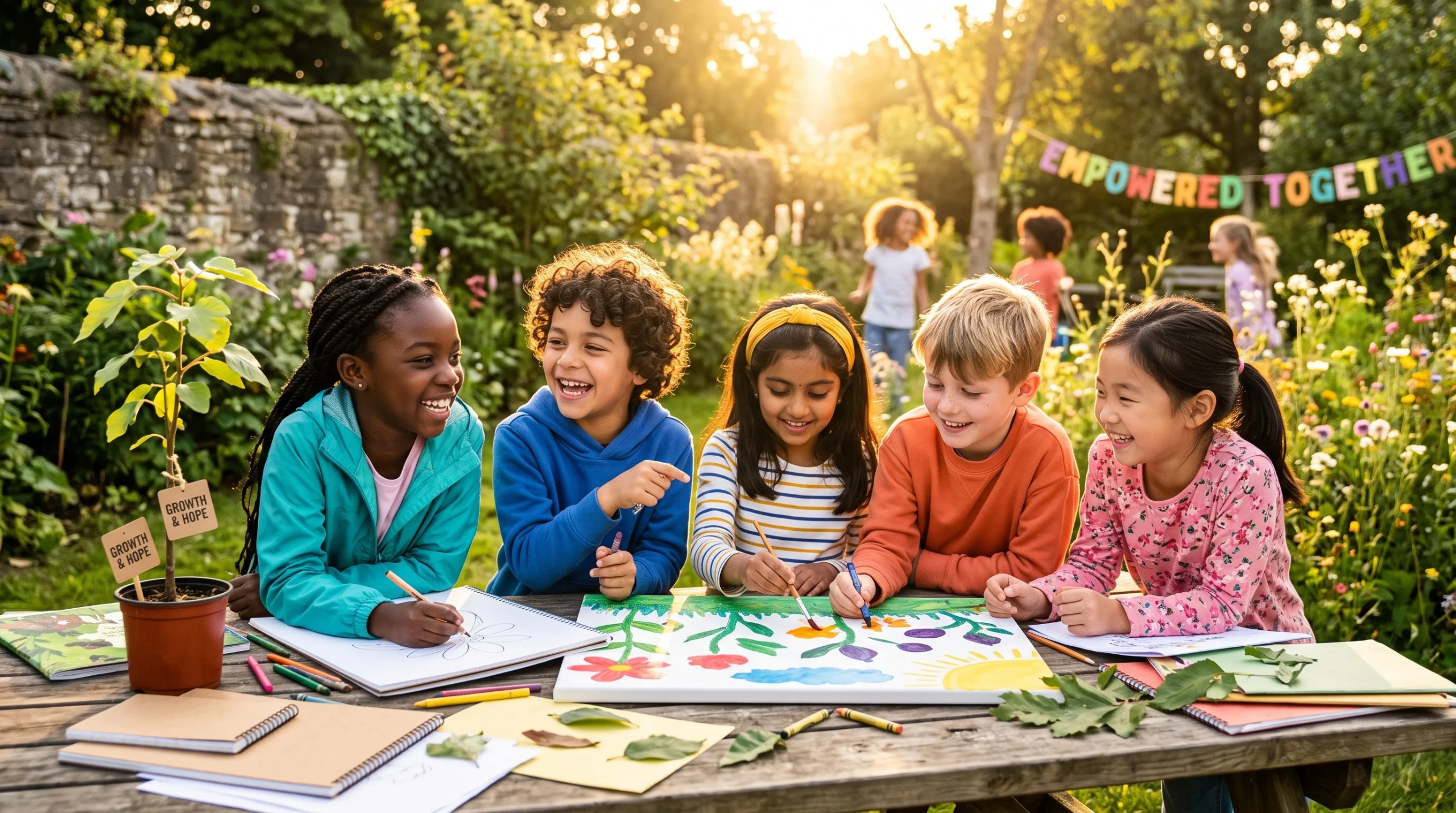
Moving beyond traditional charity by fostering collaboration, creativity, and resilience among empowered children.
Casal dels Infants – Recent data from Eurostat (2023) indicates that nearly one in four children across the European Union faces the risk of poverty or social exclusion, a figure that has stubbornly resisted improvement despite decades of welfare spending. This persistent statistic reveals a harsh truth about traditional social aid: while it keeps hunger at bay, it rarely alters the trajectory of a life. The real breakthrough in social work is no longer about distribution, but about empowering children for resilience, effectively equipping the next generation with the psychological and practical armor to break free from inherited cycles of deprivation.
For generations, the standard response to childhood poverty has been reactive. Governments and NGOs distribute food parcels, clothing vouchers, and emergency cash transfers. While these interventions are undeniably vital for immediate survival, they operate on a deficit model that views the poor as helpless beneficiaries rather than active agents of change. This approach creates a culture of dependency where families wait for the next delivery rather than mobilizing their own resources to solve problems.
Furthermore, this reactive model often ignores the complex psychological web of poverty. Children growing up in volatile environments do not just lack material goods; they lack stability, predictability, and a sense of control over their lives. When aid is given without a strategy for empowerment, it inadvertently reinforces the message that the child is a victim of circumstance, eroding the very self-efficacy needed to transcend their environment.
Field observations from various urban intervention programs suggest that temporary relief can sometimes disrupt long-term coping mechanisms. When families become reliant on irregular aid flows, they often stop utilizing existing informal support networks or community reciprocity systems. The result is a fragmented social fabric where the only lifeline is the institution, leaving the community more vulnerable than before when that support is withdrawn.
True resilience is not a personality trait but a set of learnable skills and environmental conditions. In the context of social programs, this means shifting the focus from what the child lacks to what the child can do. Programs prioritizing empowering children for resilience focus on three core pillars: emotional regulation, social connection, and skill mastery. By integrating these pillars into after-school activities and community centers, social workers can transform safe spaces into incubators for future success.
For instance, a child who learns to manage conflict through peer mediation at a local community center is not just learning to behave; they are learning negotiation skills applicable in the future workforce. A teenager who helps organize a community event is not just filling time; they are learning project management and leadership. These competencies accumulate over time, creating a psychological buffer against stress and a practical toolkit for adulthood.
The success of these programs is rarely found in attendance logs alone. During a longitudinal study conducted in Barcelona’s Raval district between 2019 and 2022, researchers found that children involved in holistic empowerment programs showed a 40% higher rate of school completion compared to the local average. More importantly, these children demonstrated significantly lower cortisol levels, a biological marker of stress, suggesting that the psychological benefits of agency and control are tangible and measurable.
Read More: Empowering the Future: Transforming Disaster Resilience for Lesotho’s Children and Communities
When resilience becomes the program goal, the role of the family shifts from passive recipient to active partner. This paradigm change reknits the social fabric. Parents who are engaged in their children’s empowerment process often rediscover their own sense of agency. They transition from being clients of the system to being co-creators of their community’s well-being. This shift is critical because a resilient child cannot thrive in a fragile household; the two must be strengthened simultaneously.
However, this approach requires patience. Unlike a food handout which provides instant gratification and visible results, building resilience is a slow, invisible process. The fruit of these efforts may not be seen for years, making it a hard sell for donors and policymakers who are accustomed to quarterly reports and immediate metrics of success. Yet, the long-term social ROI of a resilient adult contributing to the economy far outweighs the recurring cost of supporting a dependent family.
Read More: Children and Youth as Agents of Change for Disaster Resilience: Empowering Young
One critical oversight in many child-focused programs is the isolation of the child from the parent’s reality. An insightful analysis of community interventions reveals that programs focusing solely on the child often fail when the home environment remains chaotic or abusive. The breakthrough occurs when the program treats the family as a single ecosystem. If a child learns emotional regulation at a center but returns to a home where the parent is overwhelmed and unable to model those behaviors, the progress is often lost.
Therefore, the most effective strategies for empowering children for resilience implicitly involve empowering the parents. This does not mean mandatory parenting classes, which can feel patronizing, but rather creating opportunities for parents to succeed in visible ways. When a parent cooks for a community event or fixes a piece of furniture in the center, they model competence and agency for their children. This transfer of self-efficacy is more powerful than any textbook lesson on resilience.
Read More: Building Resilience In Children
To transition from theory to practice, NGOs and community centers must adopt a structured yet flexible framework. The first step is the creation of ‘third spaces’ that are neither school nor home, where children and families can experiment with new roles without the pressure of academic grades or domestic responsibilities. These spaces must be governed by clear boundaries but allow for autonomy within them.
The second step involves mentorship. Resilience is ‘contagious’; children absorb it from adults who have navigated adversity successfully. Staff in these programs should not just be social workers but mentors who share their own stories of overcoming challenges, humanizing the process of growth and making it feel attainable.
Consider a scenario where a group of at-risk youth is given a small budget to renovate a playground. Instead of hiring contractors, the program requires the youth to solicit donations, manage the budget, and perform the labor under supervision. When obstacles arise, such as a budget shortfall or a material delay, the mentor does not solve it for them but guides them through the problem-solving process. This experiential learning cements resilience in a way that a classroom lecture never could. They learn that setbacks are temporary and solvable.
Another concrete application is the ‘time bank’ system for families. Parents exchange skills and time instead of money—a graphic designer helps a neighbor with a resume in exchange for childcare. This system directly combats the isolation of poverty and builds a tangible support network. It provides immediate resources while reinforcing the community’s collective strength, proving to the children involved that their community is capable and resourceful.
Standard child protection focuses on safety and meeting basic needs to prevent harm, often reacting to crises after they occur. Empowering children for resilience is proactive, focusing on building internal strengths, coping skills, and agency before a crisis happens, effectively immunizing the child against future stressors.
The primary barriers are funding cycles that demand short-term results and a lack of training for staff in psychological resilience rather than just social work. Shifting the mindset from ‘fixing problems’ to ‘building strengths’ requires a cultural change within organizations that takes time to cultivate.
Yes, because resilience is directly linked to educational attainment and employability. Children who develop non-cognitive skills like persistence and self-control are statistically more likely to complete their education and secure stable employment, which directly interrupts the intergenerational transmission of poverty.
Children do not develop in a vacuum. A resilient child in a fragile community is like a strong plant in poor soil; eventually, the environment will hinder growth. Community involvement ensures that the ecosystem around the child supports and reinforces the skills they are learning, making the resilience sustainable.
Ultimately, the path forward lies in redefining our approach to social justice. It is not enough to simply lift children out of the water when they are drowning; we must teach them to swim. By focusing on empowering children for resilience, we do not just alleviate the symptoms of poverty today, we dismantle the machinery that produces it tomorrow.
Casal dels Infants - Community centers across Europe are quietly rewriting the rules of early learning, and the numbers behind…
Casal dels Infants - Over 67% of internationally funded child welfare interventions lose momentum within three years when local stakeholders…
Casal dels Infants - Data from the UNICEF State of the World's Children 2024 report reveals a startling disconnect in…
Casal dels Infants - Recent data from UNICEF indicates a 15% surge in anxiety among adolescents globally, revealing that academic…
Casal dels Infants - A recent longitudinal study involving 500 low-income families revealed that 70% of social aid initiatives fail…
Casal dels Infants, Barcelona - With child poverty rates in Spain remaining stubbornly high at 29.4% according to the latest…