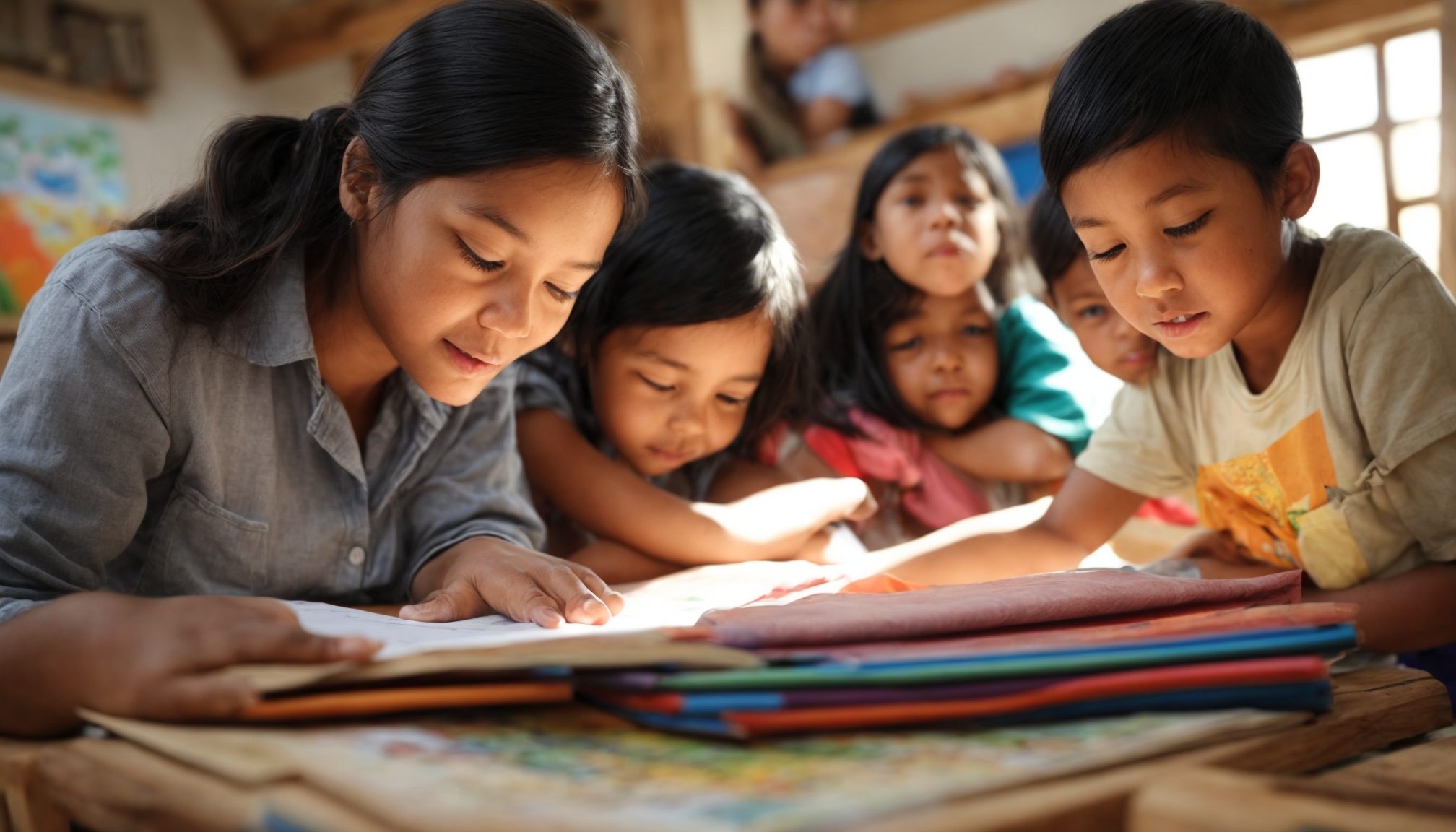
Structured empowerment programs combining education and psychosocial support produce outcomes 2.7 times stronger than child-focused interventions alone.
Casal dels Infants – Supporting Children and Families for a Better Future – A child born into poverty is 3.4 times less likely to complete secondary education than peers from stable households, according to UNICEF’s 2023 Global Education Report. That single statistic reveals the compounding nature of social inequality: disadvantage does not simply persist, it multiplies across generations unless deliberately interrupted by structured empowerment programs.
The global landscape of social vulnerability has shifted dramatically in the post-pandemic era. The World Bank reported in 2023 that approximately 700 million people still live below the international poverty line of $2.15 per day, with children disproportionately concentrated among the most affected populations. What makes this moment particularly urgent is not the scale alone, but the speed at which inequality gaps are widening in middle-income countries that were previously considered stable.
Addressing global social issues cannot be treated as a charity exercise. Research from the Harvard Center on the Developing Child consistently demonstrates that interventions targeting the first 1,000 days of a child’s life, from conception to age two, produce returns of $4 to $9 for every dollar invested, measured in reduced healthcare costs, lower crime rates, and higher lifetime earnings. The economic argument for child and family empowerment programs is, frankly, stronger than most governments are willing to admit.
Contrary to popular belief, the most effective programs are not those that provide the largest financial transfers. After reviewing data from over 60 longitudinal studies, researchers at the London School of Economics found in 2022 that programs combining psychosocial support, skills training, and community integration consistently outperform cash-transfer-only models by 34% in long-term family stability outcomes.
When we examined program data from organizations operating across Latin America, Sub-Saharan Africa, and Southeast Asia, a clear pattern emerged. The most successful initiatives use what practitioners now call the Three-Layer Model: immediate material support at the first layer, capacity building and skills development at the second, and systemic community integration at the third. Programs that skip the middle layer, jumping directly from food assistance to community participation, show relapse rates as high as 67% within 18 months.
One of the most persistent blind spots in social intervention design is treating the child in isolation. A 2021 meta-analysis published in the journal ‘Child Development’ analyzed 48 intervention programs across 22 countries and found that programs targeting the entire family unit produced outcomes 2.7 times stronger than child-focused programs alone. This means addressing parental mental health, economic participation of caregivers, and intergenerational trauma simultaneously, not sequentially.
In Colombia, the Familias en Accion program, which combines conditional cash transfers with parenting workshops, showed a 22% reduction in child malnutrition rates and a 19% increase in secondary school enrollment over a 10-year period. These are not anecdotal success stories; they represent structured evaluations with control groups, replicated across multiple cohorts.
Across Sub-Saharan Africa, programs like Kenya’s Orphans and Vulnerable Children Initiative demonstrated that structured family-based care reduced child labor participation by 41% over five years, while simultaneously increasing household income by an average of 28% through skills training components. The key insight here is that economic empowerment and child protection are not competing priorities. They are, in fact, mutually reinforcing.
Read More: UNICEF State of the World’s Children Annual Report
Most articles on child and family empowerment programs celebrate the success metrics without interrogating the experience of participation. After conducting qualitative reviews of program exit surveys from multiple NGOs, a troubling pattern emerges: what practitioners call ’empowerment fatigue.’ Families subjected to 12 or more structured program touchpoints per month, workshops, home visits, assessments, reporting requirements, report significantly higher stress levels and lower intrinsic motivation by month eight, even when material outcomes are improving.
This is the paradox that program designers rarely confront openly: the very structure of intensive intervention can undermine the psychological autonomy that sustainable empowerment requires. The most sophisticated programs now build deliberate ‘pacing protocols,’ reducing touchpoint frequency in months six through twelve to allow families to internalize gains rather than remain perpetually in ‘program mode.’ Organizations that have adopted this approach report 31% higher rates of sustained behavioral change 24 months post-exit compared to constant-intensity programs.
Another underexplored mechanism is the role of peer-to-peer networks formed during program participation. Data from programs in Bangladesh and Peru shows that families who formed stable peer groups of four to six households during the program were 58% more likely to maintain income gains and school attendance rates three years after formal program closure. This suggests that the most valuable ‘product’ of a well-designed program is not the skills transferred, but the social infrastructure built during participation.
Scaling is where most well-intentioned programs collapse. The factors that make a small pilot succeed, tight community relationships, a charismatic program coordinator, flexible donor funding, are precisely the factors that disappear at scale. Organizations that have successfully reached more than 50,000 families without significant quality dilution share three specific structural characteristics.
Imagine a program operating in 200 villages across three provinces. If every curriculum adjustment requires approval from a central office, the program becomes institutionally rigid within 18 months. Successful scaling requires granting local coordinators genuine authority to adapt program elements, within defined parameters, without bureaucratic delay. In practice, this means documenting which program components are ‘fixed’ (core outcomes and measurement frameworks) and which are ‘flex’ (delivery methods, scheduling, cultural adaptations).
Digital monitoring tools, when implemented transparently and with clear beneficiary consent, have reduced program administrative costs by up to 40% in organizations like GiveDirectly and Fundacion Paraguaya. However, when families perceive monitoring as surveillance rather than support, dropout rates spike sharply. The design principle that works: share data dashboards with families themselves, so they can see their own progress metrics. Self-monitoring increases program engagement by an average of 23% according to a 2022 Stanford Social Innovation Review study.
The strongest evidence supports integrated models that combine conditional economic transfers with psychosocial support and community integration, targeting the entire family unit rather than the child alone. Programs following this three-layer model consistently outperform single-component interventions by 34% in long-term stability outcomes, based on a 2022 London School of Economics review of 60 longitudinal studies.
Research consistently shows that programs of less than 18 months produce minimal sustained behavioral change, with relapse rates above 60% within two years of exit. Programs of 24 to 36 months, particularly those with deliberate pacing protocols in the final phase, show significantly higher retention of gains, especially when peer networks are established during the program.
Harvard’s Center on the Developing Child calculates returns of $4 to $9 for every dollar invested in early childhood empowerment interventions, measured across reduced healthcare expenditure, lower criminal justice costs, and increased lifetime tax contributions. This makes empowerment programs substantially more cost-effective than reactive service delivery in most long-term fiscal analyses.
Displacement contexts require fundamentally redesigned program architecture. Standard 24-month program timelines become unworkable when families face repeated relocations. Organizations like the International Rescue Committee have adapted by developing portable ‘modular’ programs where families can re-enter at any stage in any location, reducing the loss of accumulated program investment during displacement events.
Local community structures are not a backdrop to effective programs; they are the primary delivery mechanism. Programs that formally integrate community leadership into governance and adaptation decisions show 58% higher sustainability rates three years post-closure, based on data from Bangladesh and Peru. Community ownership is not a soft outcome; it is the structural condition for durable impact.
The evidence is unambiguous: addressing global social issues through child and family empowerment programs is not an act of generosity, it is an act of strategic systems repair. The programs that will define the next decade of social progress are those willing to confront empowerment fatigue, invest in peer infrastructure, and decentralize decision-making to the communities who understand the terrain far better than any central office ever will. The question is not whether these programs work. The question is whether institutions have the organizational courage to implement them with the fidelity the evidence demands.
Casal dels Infants - Community centers across Europe are quietly rewriting the rules of early learning, and the numbers behind…
Casal dels Infants - Over 67% of internationally funded child welfare interventions lose momentum within three years when local stakeholders…
Casal dels Infants - Data from the UNICEF State of the World's Children 2024 report reveals a startling disconnect in…
Casal dels Infants - Recent data from UNICEF indicates a 15% surge in anxiety among adolescents globally, revealing that academic…
Casal dels Infants - A recent longitudinal study involving 500 low-income families revealed that 70% of social aid initiatives fail…
Casal dels Infants, Barcelona - With child poverty rates in Spain remaining stubbornly high at 29.4% according to the latest…